← INDEX/WORK/VERIDOSE

№ 03 — RADIATION-ONCOLOGY AI

Veridose

Anyone can ship an auto-contour model. The question is: who signs their name to it?

TYPEVenture · Startup
YEAR2026
ROLECo-founder · Engineering, product, design
STATUSWorking demo · Investigational, not clinical
SCOPEMedical imaging · ML inference · Trust systems

Why this exists

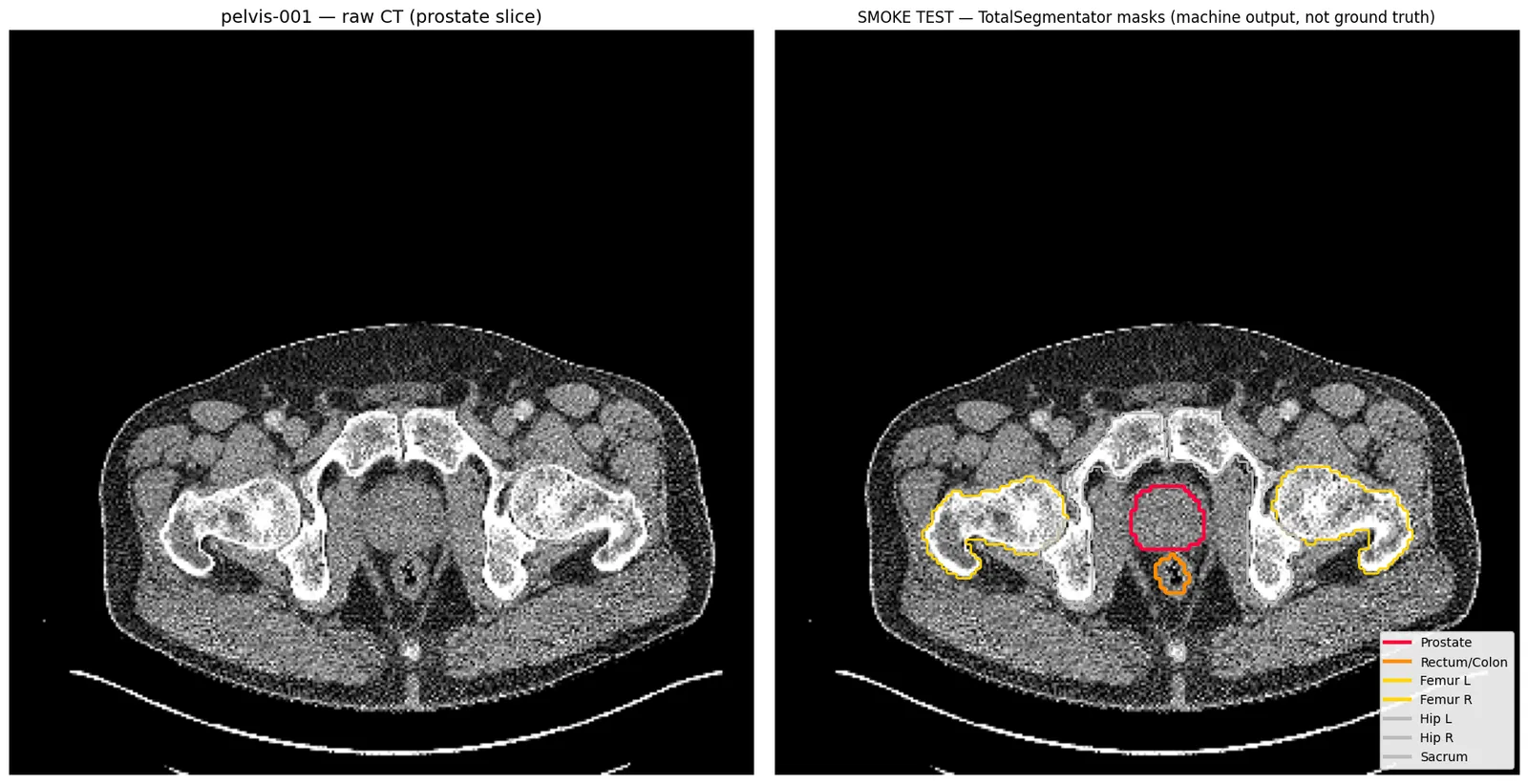
In radiation therapy, clinicians hand-trace every organ on every CT slice — the contour is the treatment plan. It’s slow, and it fails exactly where it matters most: the prostate/bladder/rectum region has almost no visible density edge for classical tools to find.

Veridose’s answer is two-sided. Technically: AI contouring built on learned 3D shape priors rather than pixel intensity. Commercially: accountability as the moat — every model release reviewed and cryptographically signed by a named, board-certified medical physicist (my co-founder, Maurice Tajiran, MS, DABR), with public per-anatomy benchmarks and a tamper-evident audit trail.

What I engineered

INFERENCE

A real auto-contour API

FastAPI service running TotalSegmentator (nnU-Net v2) on staged CT cases with GPU inference on an RTX 5070 Ti. Per-anatomy NIfTI masks stream into a multi-label volume one file at a time — holding RAM near 80 MB instead of ~3 GB.

PROOF

Quantifying why intensity fails

On a real pelvis CT (public TCIA data — no PHI ever committed), the pipeline measured that ~80% of soft-tissue voxels have sub-threshold gradient: there is literally no edge to segment. That number is the thesis — shape priors or nothing.

VIEWER

In-browser 3D medical imaging

A NiiVue-based multiplanar viewer overlaying ten segmented structures on the CT with per-structure colormaps, opacity controls, slice scrubbing, and axial / coronal / sagittal / 3D modes.

LEDGER

witness.py — the trust primitive

A hash-chained, tamper-evident ledger for linac calibration attestations (TG-51 / TG-142). Flip a single byte anywhere in history and the chain visibly breaks; validation runs on every read. The signature-as-moat thesis, embodied in code.

SHADER

Hand-written WebGL scanner

A from-scratch GLSL fragment shader — FBM tissue grain, a sweeping scan line, converging dose beams, pulsing isodose rings — with a 30 fps cap, DPR clamping, IntersectionObserver pausing, context-loss recovery, and full reduced-motion fallback.

SITE

Clinical-grade marketing front

Next.js 16 / React 19 / Tailwind v4 with bespoke effects (no component library), NASA-blue trust palette, monospace verification motifs, and honest labeling: every illustrative number marked as such.
In the wild

Raw pelvis CT vs. TotalSegmentator output — the soft-tissue region where thresholding has no edge to find
RAW PELVIS CT VS. TOTALSEGMENTATOR OUTPUT — THE SOFT-TISSUE REGION WHERE THRESHOLDING HAS NO EDGE TO FIND
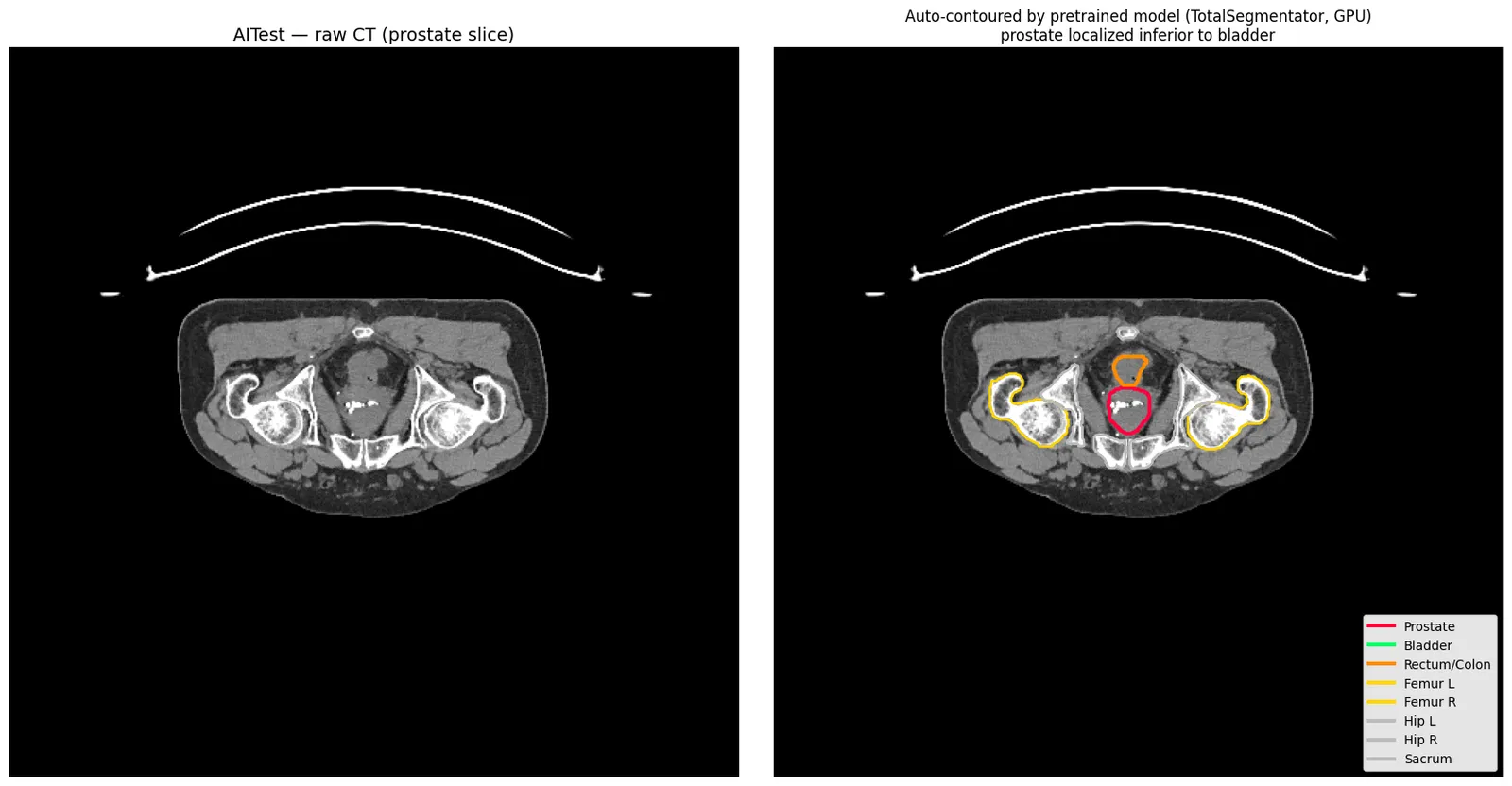
Prostate contoured on a real CT slice — learned shape priors where intensity fails
PROSTATE CONTOURED ON A REAL CT SLICE — LEARNED SHAPE PRIORS WHERE INTENSITY FAILS
10STRUCTURES RENDERED IN 3D
~80MBINFERENCE RAM (VS ~3GB NAIVE)
0PATIENT RECORDS TOUCHED — PUBLIC DATA ONLY
PythonFastAPIPyTorch cu128TotalSegmentatornnU-Net v2SimpleITKpydicom · nibabelNiiVueWebGL / GLSLNext.js 16React 19Tailwind v4NetlifyTailscale Funnel

That I can walk into a regulated, unforgiving domain — medical physics — and ship a working end-to-end system: real GPU inference, real 3D visualization, real cryptographic audit machinery, and marketing that respects the line between demo and clinic.