Small and mid-size practices on older EHRs undercode out of audit fear, get downcoded by payers, and cannot prove what happened. The design partner is a Houston multi-specialty practice: eleven clinicians, about 3,300 visits a month, billing through a remote-desktop window into a 2000s-era EHR. One 99213 that the note supports as a 99214 is about $55 at the practice’s rates; the working model puts its yearly leak at $180k–257k. Every other tool suggests the code. RevProof defends it: each code carries its quotes, the rule that produced it, who approved it, and a seal that shows nothing changed afterward.
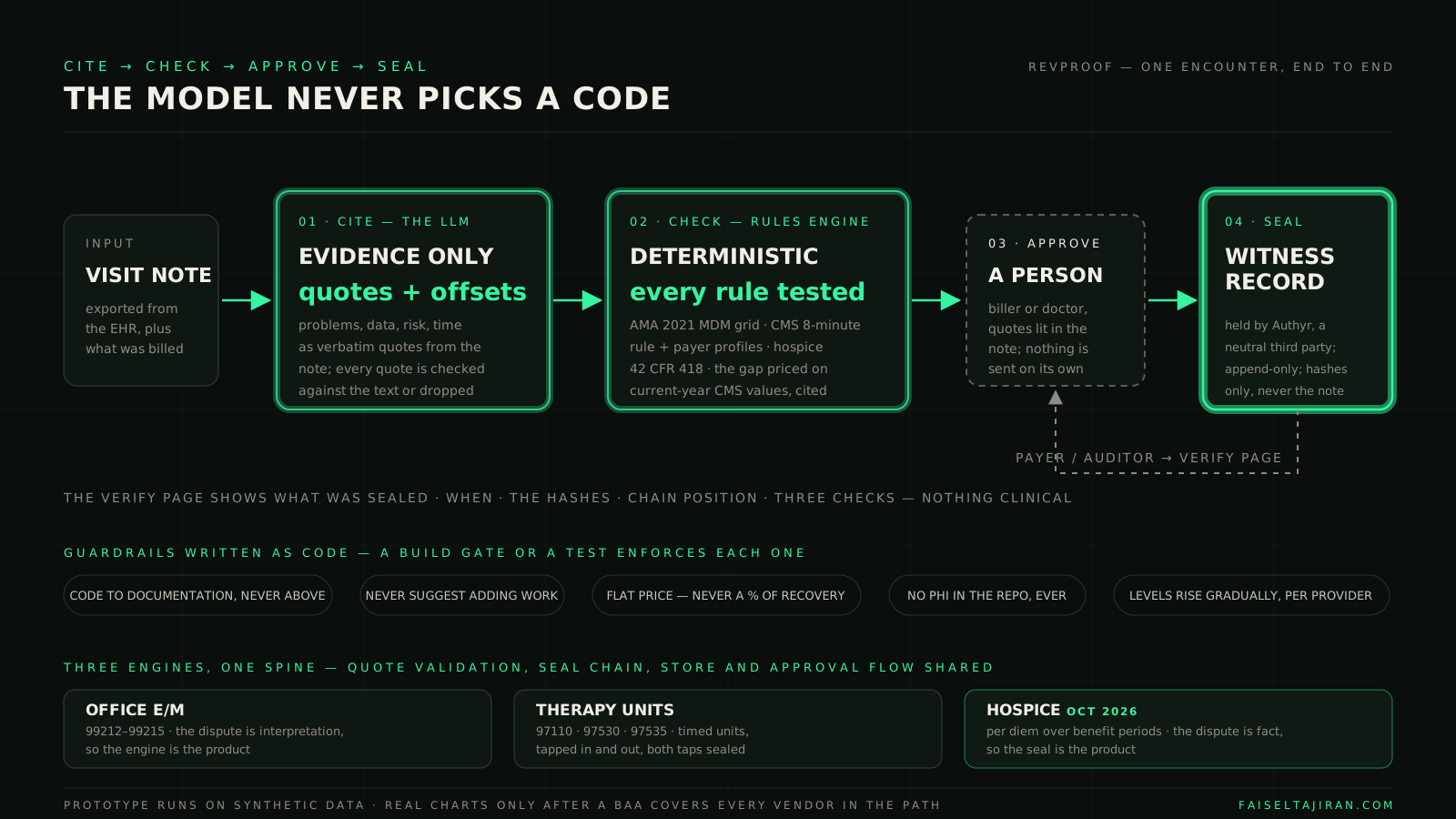
The architecture is the compliance posture. An LLM (Claude) extracts evidence only: problems, data, risk and time as verbatim quotes with character offsets, each validated against the note text, with anything unverifiable dropped before it is shown. A deterministic TypeScript engine applies the AMA 2021 decision-making grid, the CMS 8-minute rule and payer therapy profiles, and prices the gap on current-year Medicare values pulled from the CMS files. A person approves every change. Prompts for a missing sentence appear only when the note shows the work was done, never to add work. Pricing is flat per provider, never a share of recovery, because a percentage pays the vendor to code higher. First live eval: 95% level agreement on 40 notes with both misses upward, then a prompt revision to 140 of 140.
The seal makes the record checkable without trusting the practice or the vendor. The note’s fingerprint at signing, each therapy session’s tap in and tap out, and every approval land on append-only witness records held by Authyr, my other venture, kept strictly as a neutral third party: the UI says “sealed by Authyr” and nothing more, hashes only, never the note. In October 2026, with a hospice owner at the table, the product grew a second engine. Office E/M disputes interpretation; hospice disputes fact, so there the sealed record is the product and the engine is the assistant.